
Bridging the Digital Gap for the Deaf Community
Select any text on a licensed website and Isharat plays it back in real, human-recorded Arabic Sign Language — not an avatar, not a guess, and reviewed by the Deaf community's own representative union.

Precise Sign Matching, Always Improving
When a visitor selects text, Isharat instantly matches each word against a growing library of thousands of real, human-recorded signs and plays the correct video back — no waiting, no complicated setup. That library isn't static: new words, expressions, and sign videos are added on an ongoing basis, and we're targeting to grow real, measured sign coverage from today's 70.3% toward 80%+ as that work continues. The growth is demand-driven, not guesswork — every time a word doesn't yet have a recorded sign, the request is automatically logged and ranked by how often it comes up, giving our content team a real priority list for exactly which signs to record next.
Arabic includes words that are spelled identically but carry different meanings, and in sign language a different meaning can call for a different sign. When a word like this comes up, Isharat is built to offer visitors a quick pick-list of the candidate signs so they can choose the right one, rather than leaving them guessing. We're also actively developing context-understanding technology — teaching the system to recognize which meaning is intended directly from the sentence — one of the most significant translation-quality enhancements on our roadmap, aimed at making manual selection increasingly rare.
For the small number of words without a recorded sign yet, Isharat automatically spells them out letter-by-letter using the Arabic finger-spelling alphabet, so visitors always get a translation rather than silence. Numbers are handled automatically too — read aloud in sign for everyday numbers, and digit-by-digit for phone-number-style sequences.
Arabic Sign Language Has Its Own Grammar
Signing a sentence isn't swapping each word for a gesture. Word order changes, function words disappear, and tense and negation are carried by their own dedicated signs.
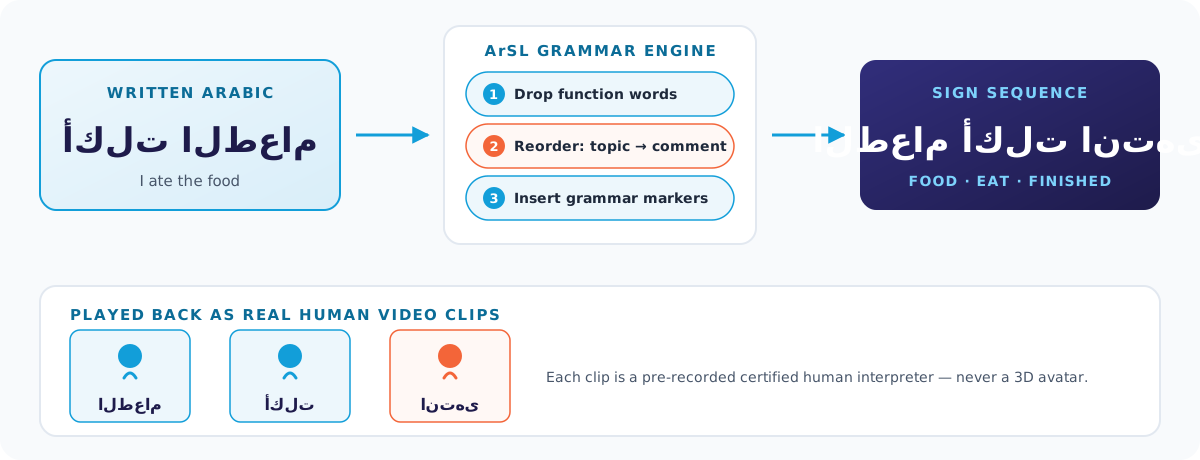
Isharat's grammar engine does three things before a single video plays: it removes articles, conjunctions, and prepositions that sign language doesn't use; it reorders the sentence into natural topic-then-comment structure; and it inserts grammatical markers — a sign meaning انتهى ("finished") to mark a completed past action, or لا to carry negation.
| Written Arabic | Sign sequence | English gloss |
|---|---|---|
| من سيستقبلكم في المطار؟ | المطار يستقبل من؟ | Airport · receive · who? |
| لماذا سافرت إلى أمريكا؟ | أمريكا سافرت سبب؟ | America · travel · reason? |
| أحمد لم يذهب | أحمد يذهب لا | Ahmed · go · negative |
| أكلت الطعام | الطعام أكلت انتهى | Food · eat · finished |
Notice the pattern: the topic comes first (المطار, أمريكا, الطعام), then what's being said about it, then the question or tense marker at the end. Sign sequences above were confirmed with Deaf reviewers.
Deaf Viewers Tell Us When a Sign Is Wrong
The only people who can properly judge a sign translation are the people it's for. So we ask them, under every video.
Shown here as a static example — the live version appears under the video inside the widget.
Those ratings do two things. They guide our translation-quality work — which sense the engine picks for an ambiguous word, how natural the sign ordering feels, and which missing signs get filmed first. And a translation marked 😕 Unclear automatically deactivates its own cached entry, so the next person to request that sentence gets a freshly generated translation rather than the one just reported as wrong.
Honestly Sized
Every one of these is a real, pre-recorded human sign-language video — not computer-generated.
Not Avatars, Not Guesses
Every sign in Isharat's library is a real, human-recorded video — no synthetic avatars, no AI-generated hands. Visitors can choose between two real interpreters for their preferred presentation style, and the platform's regional-selector architecture is designed to grow to more presenters over time.
- Real interpreters recognized by the Egyptian government and approved members of the Saudi Deaf Union
- Two selectable presenter styles today, with a "Country" selector architected for regional growth
- Human warmth and facial expression a synthetic avatar can't yet replicate

Built on a National Standard, Not Guesswork
Isharat's Egyptian sign content comes from the national Unified Sign Language Dictionary our own team developed — announced on the Egyptian Presidency's own portal, and carried out together with the Ministry of Communications and Information Technology, the Ministry of Education, the Ministry of Social Solidarity, and the Teachers Academy. It's in active use across virtually every Deaf school in Egypt today, and published as the educational dictionary platform (subscription required for full access), whose 10,000+ entries record each word in the several forms a learner needs to see. Isharat's translation library counts distinct entries instead — 8,700+ base words and 2,600+ idioms, one sign per meaning.
Every recorded sign was additionally reviewed and approved under a signed protocol with Egypt's Union of Deaf Associations — the review authority here is the Deaf community's own representative body, not Isharat's engineering team. Interpreters are recognized by the Egyptian government and are approved members of the Saudi Deaf Union. Sign content for the wider region is sourced from official dictionaries published by the Arab League's regional initiative (Qatar) and the United Arab Emirates.
Together, this represents the common Arabic sign vocabulary shared across Egypt and the Gulf — comparable to how Modern Standard Arabic functions as a shared reference across the Arab world's spoken dialects.
Measured, Not Estimated
The remaining share isn't purely "content we haven't recorded yet" — it's a mix of proper names (which typically never get their own sign, similar to how names don't get custom letterforms in writing), genuine dictionary gaps we're actively closing, and expressions the Deaf community itself hasn't yet settled on a sign for.
What's Beta, What's Next
Isharat's regional-dialect and grammar-aware settings are visible in the widget today — the architecture was designed from day one to support them. They're labeled Beta because they're real, active work, not because they're finished.
Grammar-Aware Verb Signs
Sign sequences reflecting tense, gender, and plural — the underlying data and recorded markers exist; the assembly logic is still evolving.
Multi-Dialect & Any-Language Input
Country and dialect selectors exist in settings, and the engine is evaluated against a published 200-sentence bank spanning MSA, Egyptian, Gulf, Levantine, and Maghrebi. Today's dictionary is still 100% the shared common-Arabic set; input in other source languages is under active testing.
Context-Aware Sign Selection
Meaning-aware matching for words spelled identically that carry different meanings. On our benchmark it cuts finger-spelling from 26.8% to 7.9% — but it is not yet the engine running on every production customer site.

Frequently Asked Questions
Can we add other sign-language interpreters to the translation platform?
Yes — we can arrange to add your choice of interpreters to Isharat as a customization option.
Can we request specific full-paragraph translations for our website?
Yes — we can add your custom translated paragraphs to Isharat's translation widget for your site as a customization option.
Are the sign-language signs understood across Arab countries?
Isharat's current signs can be considered the Modern Standard Arabic of sign language — most are recognized across Arab countries. Some signs do differ by local culture, and Isharat is architected to add localized sign-language videos as that need comes up.
Government, NGO, or Institution?
We collaborate with organizations who want to expand and improve Arabic sign-language accessibility together.
Request a Demo