AI-Powered Web Accessibility & Real Human Sign Language
Meaning in sign. Images in words. For every public digital service.
Signs what a sentence means — not what its words spell.
One line of code adds an Arabic-first access layer to any website: real human interpreters that sign what a sentence means, AI descriptions that read every image aloud, and 19 accessibility tools — with no redesign.
Isharat: Arabic sign language and AI image description for government and education portals
Why it matters
Sign is a Deaf person's first language. An undescribed image is silent.
Sign is their first language — written Arabic, any other language or dialect, is a second one
So text alone is not access. And some sign tools translate word by word: on Arabic words with two meanings they are right 50% of the time — chance. أمي becomes “my mother” instead of “illiterate”. Service instructions, notices, alerts, required documents and form fields on government sites still need a family member or a local sign interpreter.
Answered by: the AI meaning engine
Illustration: a service’s steps, in Arabic, only inside an image
What is inside an image is silent unless it is described
Diagrams, infographics, procedures shown as steps in an image, and Arabic text inside images — notices, forms, labels. 53.1% of the top one million home pages have images with no text alternative — 10.8 per page. The screen reader reads a file name, or nothing; Arabic descriptions are rarely offered.
Answered by: AI image description
78Mpeople with hearing loss — WHO Eastern Mediterranean Region
24.9Mblind or with moderate-to-severe vision loss — North Africa & Middle East
53.1%of top home pages have images without alt text
95.9%of top home pages fail WCAG 2 — institutions cannot rebuild every portal
Standards we align with: WCAG 2.2 AA · Saudi DGA controls · first-party audit ISH-AUD-2026-v2.4-CR
Platform
Everything Your Visitors Need, In One Widget
19 accessibility tools, real sign-language translation, and enterprise-grade branding — all live today unless marked otherwise.
Accessibility Toolbar
19 tools plus 8 one-click modes — screen reader, bigger text, contrast, dyslexia font, reading mask, big cursor, and more — adjustable per visitor, no changes to your site's code.
Select any text and Isharat plays it back in real, human-recorded Arabic Sign Language — sourced from Egypt's national Unified Sign Language Dictionary, reviewed by Egypt's Specific Union of Deaf Associations. Every translation carries a three-level comprehension rating so Deaf viewers can tell us when a sign is wrong.
Blind and low-vision visitors get real AI-generated descriptions of every image, at three detail levels — applied as real alt text, compatible with their own screen reader. It reads text inside images in both Arabic and English, and leaves human-written alt text alone unless the visitor asks it not to.
Built for B2B and B2G customers: match the widget's colors, fonts, logos, and content to your own brand or government design system — no rebuild required.
Isharat's Arabic sign-language library is grounded in Egypt's national Unified Sign Language Dictionary and reviewed by Egypt's Specific Union of Deaf Associations — real human interpreters with real facial expression, chosen by meaning. It's built on an architecture designed from day one to adapt across regions, with a growing roadmap to extend beyond Arabic into other sign languages, including ASL and BSL, as we expand into new markets.
8,368 signs — one per meaning, each recorded by a real interpreter — 2,600+ full idioms and expressions, and hundreds of thousands of verb-conjugation videos
Sourced from Egypt's national dictionary, the Arab League (Qatar), and the UAE's official dictionaries
Localizable sign videos — each country’s signs and interpreters are data, not code: they are linked to that country, and the visitor chooses them in the widget settings.
70.3% of words get a real recorded sign today — and that share keeps growing
A three-level comprehension rating under every translation, answered by Deaf viewers themselves
~0.2 seconds to replay a sentence already translated (cached)
Localizable sign videos — the interpreter and signs for each country: Qatar · Egypt · KSA…
Grounded in Official Standards
Built on a National Standard, Not Guesswork
Isharat’s signs are Unified Arabic Sign Language — built on Egypt’s national Unified Sign Language Dictionary, with the Arab League’s regional dictionary (Qatar) and the UAE’s official dictionaries.
Where the signs come from, who approved them, and how the dictionary keeps growing.
Egypt's National Dictionary
Isharat's sign vocabulary comes from the national Unified Sign Language Dictionary (القاموس الموحد للغة الإشارة) our own team developed — announced on the Egyptian Presidency's portal, and carried out with the Ministry of Communications and Information Technology, the Ministry of Education, the Ministry of Social Solidarity, and the Teachers Academy.
Every recorded sign was reviewed and approved under a signed protocol with Egypt's Union of Deaf Associations (الاتحاد النوعي لجمعيات الصم). The review authority is the Deaf community's own representative body — not Isharat's engineering team. Our interpreters are certified by Egypt's Specific Union of Deaf Associations (الاتحاد النوعي لجمعيات الصم).
The Dictionary Keeps Growing
Finger-spelling is a normal part of sign language, used for proper names and brand-new technical terms. Isharat logs every finger-spelled word across all customer sites automatically, and our linguistic team uses that live queue to decide which signs to film next in ongoing studio recording sessions.
The same dictionary is published as a full educational platform, officially approved by Egypt's Ministry of Education and the Teachers' Professional Academy and distributed to over 200 Deaf schools.
Our Accessibility Conformance & QA Division assessed the widget's own interface against WCAG 2.2 AA and the Saudi DGA controls, testing with real screen readers, keyboard-only workflows, and contrast audits. This is a first-party audit — it reports tested capability, and is not a legal guarantee of compliance for any individual website.
38 pilot testers — 20 Deaf and 18 blind — under 7 cooperation protocols with associations and community institutions
Every translation is rated by Deaf viewers (Good / Partly / Unclear), and an unclear rating retires that cached translation
Real Numbers
Isharat, Measured
Pulled straight from Isharat's own production dashboards — not estimates. Where a number comes from a Beta engine rather than live customer traffic, it says so.
Live usage, as of 14 October 2026
3institutions live today: Diwan Al-Mazalim (KSA), King Faisal University (KSA), Oman TIECSource: Contracts
1.68Munique visitors on websites running Isharat, 30 daysSource: Production monitoring
16.94Mrequests from Isharat's tools to its servers, 30 days to 14 Oct 2026Source: Network traffic analytics
85,838words translated to sign language per monthSource: Isharat dashboard
474,502words read aloud by the screen reader per monthSource: Isharat dashboard
1,389images described by AISource: Isharat dashboard
97.3%of sign-translation jobs completed (completion, not accuracy)Source: Isharat dashboard
Beta88.2%right sense chosen on 102 test sentences, vs 50% for word-by-word lookupSource: Engineering measure, not yet Deaf-rated accuracy
Beta7.9%finger-spelling rate on our 200-sentence, 5-dialect benchmark (down from 26.8%)Source: Published benchmark
Beta12.3 s · 20 msto describe the first images on a page · then from cacheSource: Real-page timing
~0.2 sto replay a sentence already translated (cached)Source: Production cache
The sign dictionary
8,368signs — one per meaning, each recorded by a real interpreter — plus 2,600+ full idioms and expressions
70.3%of words get a real recorded human sign — the remaining 29.7% are finger-spelled proper names, brand names, and terms with no standard sign yetLive customer sites, launch through 17 Aug 2026 · 112,181 words processed
~199Deaf schools in Egypt already teaching this dictionary's vocabulary
Every figure names its source. Figures are as of 14 October 2026, except where a card gives its own date. How we measure (PDF)
Recognition
Recognised in Qatar and Saudi Arabia
Mada Innovation Award 2026 · Qatar
One of 20 finalists, in the Scaling Innovation Grant category
Isharat was selected for the final stage of the Mada Innovation Award 2026, run by Mada — Qatar Assistive Technology Center, from more than 2,000 applicants (according to Mada).
The Isharat booth at ICDR 2026, Riyadh — the team joining live by video call
AI Hackathon for People with Disabilities · KSCDR · Saudi Arabia
A finalist among 2,251 participants — shown at ICDR 2026 in Riyadh
Isharat was shortlisted as a finalist in the AI Hackathon for People with Disabilities, organised by the King Salman Center for Disability Research, which drew 2,251 participants in 918 teams. We presented Isharat at our booth at the 7th International Conference on Disability and Rehabilitation (ICDR 2026), King Faisal Conference Center, Riyadh, 11–13 October 2026.
One line of code or our REST API, an annual licence with an SLA, nothing redesigned.
Institution dashboard
In development
Your own dashboard: switch tools on per site, apply your branding, and see statistics for your entity only — tool usage, words signed and read aloud, images described. Anonymous: no disability data.
Public API for apps and kiosks
In development
Make your mobile apps and touch kiosks accessible — in airports, hospitals, courts, banks — through per-institution API keys.
Accessibility providers
Isharat’s meaning layer works before rendering, so it can serve your tools — avatars included — through the API: complementary, not competing.
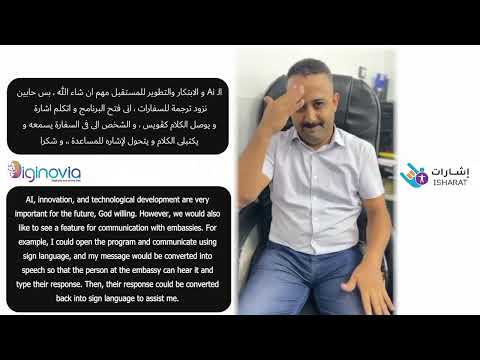
People from the Deaf and blind communities who tested Isharat, in their own words.
“I really liked this tool. It helped me understand the website better, without help from anyone.”
— Deaf participant, Isharat live test group
“I was able to describe the image and read the text inside it, without even asking. I uploaded a photo of my ID, and the description was very accurate.”
— Blind tester, Isharat live test group
“For the first time, I can get an accurate description of our foundation's logo and colours in this much detail.”
Every item below is labeled by its real maturity stage — nothing here is claimed as live until it actually is.
Live
19 accessibility tools + 8 one-click modes
filmed sign library
white-label branding
Beta
AI image description
context-aware sign selection (meaning engine)
grammar-aware verb signs
multi-dialect and any-language input
In development
Faster meaning engine (v2)
sign icon beside every paragraph, wired to the engine
sign-video management panel
institution dashboard
public REST API for mobile and kiosk apps
Qatari and Gulf sign variants (localizable sign videos)
independent third-party WCAG 2.2 AA audit
field study with Deaf and blind users
Future
Interactive kiosks in public places (banks, hospitals, airports, trains, telecom service centres, police stations)
ASL, BSL and other sign languages
optional photorealistic signers, created with consent and customised per institution
a live interpreter video call as fallback
per-website coverage scanner
FAQ
Frequently Asked Questions
What is Isharat?
Isharat is an AI-powered web accessibility widget. Adding one line of code to a website gives visitors a customizable accessibility toolbar and real, human-recorded Arabic sign-language video translation, with no changes needed to the host site.
Is Isharat WCAG 2.2 and Saudi DGA compliant?
Isharat provides tools that help remediate common accessibility barriers on any website. Compliance with WCAG 2.2, Saudi DGA, or any other standard depends on the underlying website itself; enabling Isharat does not certify or guarantee that compliance on its own.
How does the Arabic sign-language translation work?
A visitor selects text and Isharat looks each word up in a library of 8,368 human-recorded signs and 2,600+ recorded idioms, based on Egypt's national Unified Sign Language Dictionary. Measured across every customer site from launch through 17 August 2026 — 112,181 words processed — 70.3% of words got a real recorded sign and 29.7% were finger-spelled.
Does Isharat use avatars?
Today every sign is a pre-recorded video of a real, certified human interpreter. AI works behind the scenes — it understands the sentence and picks the right sign — it does not generate the signer. Isharat's meaning layer works before anything is rendered, so it can also serve avatar-based tools: we see avatars as complementary, not competing. On our roadmap: optional photorealistic signers, created from our interpreters with their consent and customised per institution — always as a choice, never replacing the filmed interpreters. Whoever signs, human or digital, facial expression and mouthing matter: in Arabic Sign Language they carry grammar and meaning, so we will only offer a digital signer that keeps them.
Why does Isharat finger-spell some words?
Finger-spelling is a normal, essential part of natural sign language. It's used for proper names — people, cities, company and brand names — and for newly coined technical terms with no dedicated sign in standard dictionaries. Every finger-spelled word is logged automatically, and our linguistic team uses that queue to prioritise which new signs to film in ongoing studio recording sessions.
Can Isharat handle Arabic dialects or text in other languages?
Isharat's AI context engine is built to normalise regional Arabic dialects — Egyptian, Gulf, Levantine and Maghrebi — and to translate text from other source languages into Arabic Sign Language. This is currently in Beta: the selectors are live in the widget and the engine is evaluated on a published 200-sentence, 5-dialect benchmark, but it isn't yet the engine running on every production customer site.
Can Deaf users tell Isharat when a translation is wrong?
Yes. Every sign translation carries a three-level comprehension feedback bar below the video: Good / Accurate, Partially Understood, and Unclear / Not Understood. A translation marked unclear automatically deactivates its cached entry so the engine regenerates a fresh translation on the next request, and the ratings feed our ongoing translation-quality work.
Is the AI Image Description feature available today?
It's in Beta. It is built and working end-to-end, offering three levels of detail, but currently runs on staging infrastructure rather than being promoted across every customer site.
Can Isharat match our own brand or government design system?
Yes. For B2B and B2G customers, colors, fonts, both widget logos, the trigger button style, and the widget's About tab and footer content can all be customized per subscribing website.
Can we add other sign-language interpreters to the translation platform?
Yes — we can arrange to add your choice of interpreters to Isharat as a customization option.
Can we request specific full-paragraph translations for our website?
Yes — we can add your custom translated paragraphs to Isharat's translation widget for your site as a customization option.
Are the sign-language signs understood across Arab countries?
Isharat's current signs can be considered the Modern Standard Arabic of sign language — most are recognized across Arab countries. Some signs do differ by local culture, and Isharat is architected to add localized sign-language videos as that need comes up. Sign videos are localizable: a country’s own variants and interpreters can be added and linked to that country — Qatari and Gulf variants are in development.
Is Isharat an overlay that makes my site compliant?
No. Isharat adds what a site cannot provide — sign video and Arabic image descriptions — plus visitor-side tools. It does not fix your code or certify compliance; source fixes stay with the site owner.
Can the signs be localized for my country?
Yes. Sign videos and interpreters are data, not code: a country’s own variants and interpreters can be added and linked to it. Qatari and Gulf variants are in development.
Does Isharat replace human interpreters?
No. It makes everyday web content accessible. It is not a substitute for qualified interpreters in legal, health or court settings; a live-interpreter video call is on our roadmap as a fallback. See our Responsible AI principles.
Do you offer an API for mobile apps and kiosks?
It is in development: a public REST API with per-institution keys, so apps and touch kiosks can show Isharat’s sign translation and image descriptions.
Ready to Make Your Site Speak to Everyone?
Talk to us about a demo, pricing, or a white-label partnership.